For more information, visit the Tiaki Wai website www.tiakiwai.co.nz
Tiaki Wai name update
16 December 2025
In the interest of simplicity, after consultation with shareholding councils and mana whenua partners, the Tiaki Wai Board has decided to drop ‘Metro Water’ from the organisation's legal name. They are now Tiaki Wai Limited, or just Tiaki Wai.
This name was gifted by mana whenua. The English translation of Tiaki Wai - ‘caring for water’ - gets to the heart of the organisation's objective.
New chapter for water services in metropolitan Wellington begins
30 October 2025
The new water organisation for the metropolitan Wellington area is now legally established with the name Tiaki Wai Metro Water Ltd and a four-person Board of Directors in place.
The new organisation will provide drinking water, wastewater, and piped stormwater services for approximately 432,000 people across the Wellington metropolitan area from 1 July 2026.
The legal name Tiaki Wai Metro Water reflects that the organisation is a partnership between shareholding councils and mana whenua iwi Ngāti Toa Rangatira and Taranaki Whānui ki Te Upoko o Te Ika.
Tiaki Wai in Te Reo Māori means ‘carers for water’. This name captures the intent to deliver safe, reliable, environmentally and financially sustainable water services in a way that restores te mana o te wai. The name has been gifted by mana whenua.
Metro Water remains part of the legal name to capture that the new organisation will work across metropolitan Wellington.
Tiaki Wai Metro Water will be abbreviated to Tiaki Wai.
The Board are:
- Will Peet (chair) – Wellington-based independent director and advisor with deep experience in infrastructure, transport, technology, and public sector governance.
- Jon Lamonte – former CEO of Watercare with experience in transport and logistics.
- Elena Trout – independent director and civil engineer with experience in transport, infrastructure and energy.
- Adrian Wimmers – Wellington-based commercial and infrastructure advisor and public sector governance leader.
The Board was appointed by the Advisory Oversight Group (the council and iwi governance group that guided the development of Tiaki Wai Metro Water).
Advisory Oversight Group member and Porirua Mayor Anita Baker says the calibre and experience of the Directors will ensure Tiaki Wai Metro Water has a solid foundation.
“These four people bring a wealth of leadership experience and knowledge of infrastructure and water services. They are the people we need to set the new organisation up for success.”
Following the legal incorporation of Tiaki Wai Metro Water, the Board will hold its first formal meeting next week.
Incoming councils are expected in the coming weeks to finalise key documents and appoint the Partners Committee that will oversee Tiaki Wai Metro Water.
Will Peet (Chair)
Will is a Wellington-based independent director and advisor with deep experience in infrastructure, transport, technology, and public sector governance. A civil engineer, Will's career includes leadership roles as CEO of ONTRACK and Chief Operating Officer of the New Zealand Defence Force.
Currently, Will chairs Site Safe, is a director of Public Trust, a member of the Ministry of Education Risk and Assurance board, and serves as an external member on major project governance groups for a number of public sector organisations, including as independent chair of Te Wai Takamori o Te Awa Kairangi / Riverlink. Will is a Fellow of Engineering New Zealand, Fellow of the Chartered Institute of Logistics and Transport, and Member of the Institute of Directors.
Jon Lamonte
Jon has extensive experience in water services leadership, including being a former CEO of Watercare, and the Auckland/Northland Water Services Entity. He was also CEO of Sydney Metro, Transport for Greater Manchester, and Tube Lines Ltd (London).
Jon is a Chartered Director and Fellow of the Institute of Directors, a Fellow of the Royal Institute of Chartered Surveyors and Fellow of the Chartered Institute of Logistics and Transport.
Jon was also formerly an Air Vice-Marshal in the Royal Air Force, with director-level positions in defence procurement, logistics, and strategy.
Jon is currently a director on the Board of Waikato Waters Ltd.
Elena Trout
Elena has extensive experience as a company director and professional civil engineer who has held a number of leadership positions in the transport, infrastructure and energy sectors over the past 30 years.
Elena is currently an independent director or chair of several boards including Citycare, Callaghan Innovation, the Energy Efficiency and Conservation Authority, Local Government Funding Agency (LGFA), WorkSafe, and has recently retired from Contact Energy. She has held significant roles as an independent chair and advisor to both central and local government.
Elena is currently the chair of the Board of Waikato Waters Ltd.
Elena is a Fellow of the Institute of Directors and a past president and distinguished Fellow of Engineering NZ.
Adrian Wimmers
Adrian is a Wellington-based commercial and infrastructure advisor and public sector governance leader with more than 30 years’ professional experience across high-value infrastructure investment, complex commercial transactions and major public sector reforms.
Adrian’s career has included senior executive roles at KPMG, the New Zealand Treasury’s Crown Company Monitoring Advisory Unit and as an Acting General Manager at the New Zealand Infrastructure Commission. He has held governance roles with multiple departmental advisory boards and not-for-profit organisations including the Komiti Pasifika at Victoria University of Wellington and is currently Deputy Chair of the Fale Malae Trust.
Adrian is a Member of the Institute of Directors and CPA (Aust).
- Tiaki Wai Metro Water will own and operate drinking water, wastewater, and piped stormwater services for approximately 432,000 people across the Wellington metropolitan area from 1 July 2026. It will absorb the current provider, Wellington Water.
- It will be better set up to deliver improved services for communities, with more funding options, a regional focus and new leadership and governance arrangements.
- Improved services means more reliable water supply, reduced leaks, outages and unplanned disruptions and cleaner harbours and waterways.
- It will in time have a direct relationship with customers when they have a question or report a fault, rather than via councils.
- The region’s water assets, with a replacement value of almost $18 billion, will remain in public ownership because Tiaki Wai Metro Water is owned by five shareholding councils.
- Investment of about $25 billion will be required over 30 years, to catch up on decades of under-investment, address growth, meet new regulatory standards and deliver reliable and environmentally sustainable water services.
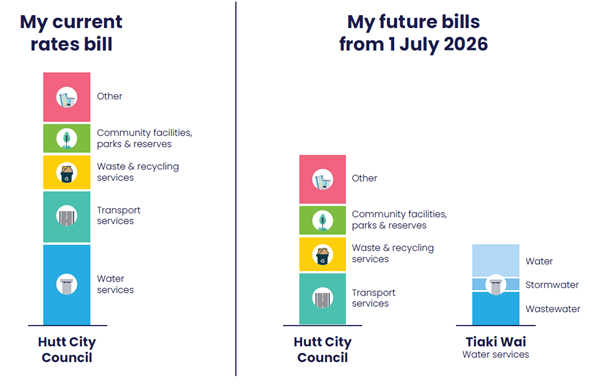
- Customers will pay directly for water services, instead of indirectly through rates. For the first financial year (2026/27) it is expected that Tiaki Wai Metro Water will operate in line with the budgets set in councils’ Long Term Plans. This means in the first year households can expect water charges to be in line with what they would have paid as part of their rates bill.
- Initially, some functions and support will continue to be provided by councils. This will continue until the necessary IT systems are in place.
- To ensure essential services continue, Tiaki Wai Metro Water will absorb the current operational and support teams from Wellington Water (tier 3 managers and below).
The initial Statement of Expectations, confirmed on 18 December 2025, is one of the key planning mechanisms that the shareholding councils and mana whenua have to influence the priorities and strategic direction for Tiaki Wai. This is because Tiaki Wai is required by legislation to give effect to the Statement of Expectations.
The Local Government (Water Services) Act 2025 sets out a range of mandatory matters that the Statement of Expectations must address, including outcomes that the shareholders expect Tiaki Wai to achieve by delivering water services. The Statement of Expectations can also address other matters that are important to the partners, such as a requirement to undertake community or customer engagement, and the contents of that engagement.
The preparation of the Statement of Expectations involved the following process:
- Input from across all Shareholding Councils, the establishment team and iwi/mana whenua partners.
- Informed by principles developed and agreed by the Shareholding Councils.
- Provided to the Board of Tiaki Wai in early November 202, to provide the Board with opportunity to comment.
- Once comments were received from the Board of Tiaki Wai, the draft Statement of Expectations was refined and then presented to the Partners Committee for consideration.
- The Partners Committee adopt the final Statement of Expectations and provided it to Tiaki Wai in December 2025.
Metropolitan Water Services Delivery Plan accepted by Government
8 October 2025
The plan for delivering water services to metropolitan Wellington residents and businesses through a new organisation with new funding and governance arrangements has been accepted by the Department of Internal Affairs.
The Metropolitan Wellington Water Services Delivery Plan was submitted by five councils - Hutt City, Porirua City, Upper Hutt City, Wellington City and Greater Wellington - as required under the Government’s Local Water Done Well policy and legislation.
The plan is based on establishing a new multi-council-owned water organisation in partnership with mana whenua iwi Ngāti Toa Rangitira and Taranaki Whānui ki Te Upoko o Te Ika. The new organisation, with the interim name Metro Water, will operate from 1 July 2026.
The Water Services Delivery Plan (WSDP) says that Metro Water will have the resources, independence and region-wide perspective to effectively manage and improve drinking water, wastewater and piped stormwater services for current and future communities, rather than being limited by council funding, electoral and decision-making cycles.
Transition planning is progressing.
A joint Partners’ Committee will be established to oversee Metro Water, made up of representatives from each partner council and mana whenua.
The foundation governance documents for Metro Water, including the constitution and partners' agreement, will be presented to each of the five partner councils for approval in December 2025.
Wellington Water Limited will continue to deliver water services on behalf of councils under the current model until Metro Water takes over on 1 July 2026.
Metropolitan Water Services Delivery Plan approved
21 August 2025
The plan for delivering water services to metropolitan Wellington residents and businesses through a new organisation with new funding and governance arrangements has been approved by the five partnering councils - Hutt City, Porirua City, Upper Hutt City, Wellington City and Greater Wellington - at meetings over the past three days.
The Metropolitan Wellington Water Services Delivery Plan will be submitted to the Government before the deadline of 3 September 2025, as required under the Government’s Local Water Done Well policy and legislation.
The plan is based on establishing a new multi-council-owned water organisation in partnership with Mana whenua iwi Ngāti Toa Rangitira and Taranaki Whānui ki Te Upoko o Te Ika.
Metropolitan Wellington councils confirm new water services delivery model
1 July 2025
Five councils covering the Wellington metropolitan area - Hutt City, Porirua City, Upper Hutt City, Wellington City and Greater Wellington Regional Council - confirmed in June 2025 that they will establish a new, jointly-owned organisation to deliver water services to their communities.
This decision follows public consultation in March and April 2025, where 69% to 84% of submissions across the five councils supported the preferred option of a multi-council-owned water organisation. The other option considered was a modified status quo.
Mana whenua iwi Ngāti Toa Rangatira and Taranaki Whānui ki Te Upoko o Te Ika support the decision and are partnering with councils to improve how water services are delivered.
Lower Hutt Mayor Campbell Barry says the decision marks a reset for water services in the region.
“The new entity unlocks the financial tools needed to make smart investments in water infrastructure, without placing an unsustainable burden on ratepayers.
“It will enable better decision-making across the entire network and ensure more consistent service delivery.”
Barry said turning around historical underinvestment in water infrastructure will take time and water bills will still increase under the new entity to meet the needs of the region’s ageing network.
The next steps are to finalise key foundation documents, submit a regional Water Services Delivery Plan to the Government, and appoint an interim board and Chief Executive.
Background – Why This Is Happening
In December 2023, the Government introduced Local Water Done Well, a new approach for managing drinking water, wastewater and stormwater services. The policy aims to ensure services are safe, reliable, and financially sustainable while meeting regulatory standards.
The need for reform has been building for nearly a decade. The 2016 Havelock North water contamination crisis highlighted the risks to community health and the importance of strong water infrastructure.
Historical underinvestment in water services across the region has also resulted in an ageing network that needs significant investment to repair, renew and meet regulatory requirements.
Water services are becoming more expensive due to:
- replacing or upgrading ageing infrastructure
- population and industrial growth
- climate change
- new safety and environmental standards
- stricter health regulations
Over time, different Governments have proposed different solutions. The previous Government favoured large regional entities. The current approach, Local Water Done Well, allows councils to retain ownership and decide how services are delivered, provided they meet national standards.
How It Works
Local Water Done Well is being rolled out in three stages, each with its own legislation. The second stage became law in September 2024. A further law introduced in December 2024 sets out long-term rules for water service delivery and requires councils to submit regional delivery plans.
The goal is to provide cost-effective water services that meet environmental and community needs while maintaining high standards.
Regional Collaboration
To support a regional approach, an Advisory Oversight Group (AOG) was established in 2024. It includes the five councils and is chaired by Dame Kerry Prendergast. Hutt City Council is represented on the AOG by Mayor Campbell Barry.
In October 2024, the group received a report recommending the creation of a new jointly owned organisation to deliver water services and bill customers directly. The new model is the result of that recommendation and subsequent community engagement.
Useful links:
- Tiaki Wai Statement of Expectations
- Department of Internal Affairs assessements of councils' WSDPs
- Find out about the public consultation in early 2025
- Wellington Region Water Services Delivery Planning Recommended regional approach to a joint Water Services Delivery Plan and delivery model
- Appendices to Report
- Appendix D: Council Profiles
- Follow progress of the Local Government (Water Services Preliminary Arrangements) Bill
- April 2024 information for councils from DIA
- DIA - water services policy and legislation
- DIA - information on the Technical Advisory Group
- DIA – Local Water Done Well legislation
- DIA – Local Water Done Well updates