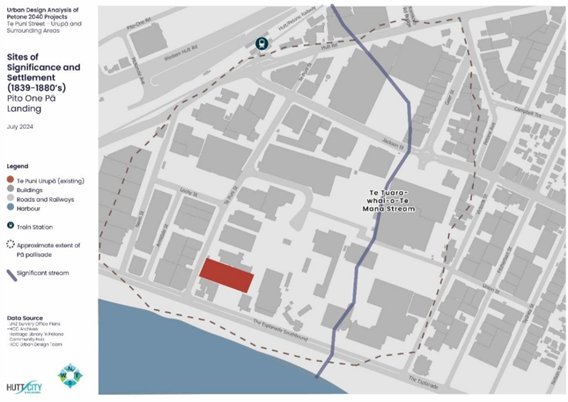
Pito One (Petone) has a rich history of both Māori and European settlement. In 1832 Hōniana Te Puni led his people on the significant overland migration known as Tama-te-uaua from Taranaki to settle along the shores of Te Whanganui a Tara. At the heart of this settlement was Pito One Pā.
The original pā was situated along the pre-1855 shoreline, further inland from the beach we know today. It holds special significance for the Taranaki Whānau tribal collective in Te Whanganui a Tara, especially the descendants of Ngāti Tāwhirikura and Ngāti Te Whiti hapū of Te Āti Awa.
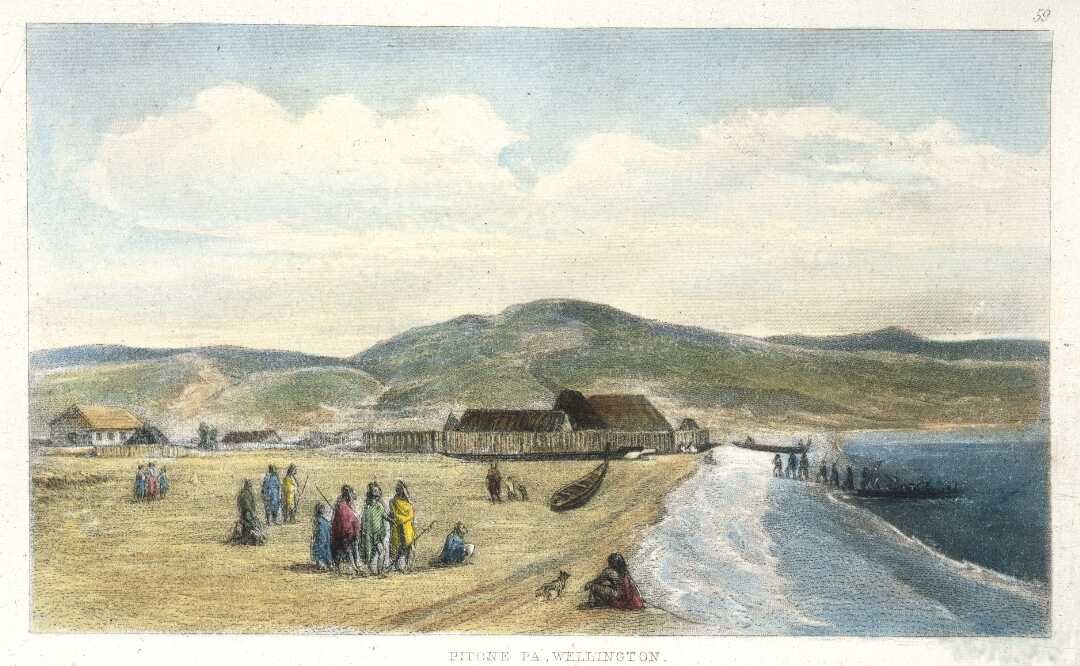 Brees, Samuel Charles, 1810-1865 :Pitone Pa, Wellington, 59. Engraved by Henry Melville. Drawn by S C Brees. [London, 1847].. Brees, Samuel Charles, 1810-1865 :Pictorial Illustrations of New Zealand. [Plate 20]. Pitone Pa, Wellington, 59; Tinakori Road Wellington, 60; Residence of His Honor Judge Halswell at Ohiro. Engraved by Henry Melville. Drawn by S C Brees. [London, 1847].. Ref: PUBL-0020-20-1. Alexander Turnbull Library, Wellington, New Zealand. natlib.govt.nz/records/23047273
Pito One boasted rich resources, with fertile lands that nurtured flourishing gardens by the river. The surrounding forests offered timber and kai (food), and the locals practiced traditional hunting and gathering in a way that honoured the land. The foreshore was integral to the community's activities, serving both as a place for mahinga kai (traditional food gathering) and a lively zone with swimming and waka (canoe).
In 1839, Te Puni and the people of Pito One Pā welcomed representatives of the New Zealand Company and the first settlers who arrived aboard the ship Tory to negotiate the purchase of what would become known as the Port Nicholson Block.

The "Cuba" and "Tory" off the Petone Beach, 8th March, 1840. digitalnz.org/records/1807928
Soon after, company officials and surveyors began laying out the foundations of the new colony, dividing the land into ‘town acre’ sections and rural blocks of 100 acres. William Wakefield, the company’s principal agent, had a house within the palisades of the pā, and early New Zealand Company buildings were erected nearby.
This moment marked the beginning of a profound transformation for Te Awa Kairangi ki Tai and played a pivotal role in the development of the city that would grow around it.
Edward Jerningham Wakefield (1845) described Pito One and the Hutt Valley:
“The village lay, as its Māori name ([Pito One], or "End of the Sand") implied, at the western end of the sandy beach, which is about two miles long. The main river falls into the sea at the eastern end, about a quarter of a mile from the hills which bound the valley to the east, and is called the [Te Awa Kairangi]. A merry brawling stream, called the Korokoro, or "throat," flows between the village and the western hills. The valley bounded on either side by wooded hills from 300 to 400 feet in height... to within a mile and a half of the beach, when swamps full of flax, and a belt of sand hummocks, intervened.”
Hōniana Te Puni passed away on 5 December 1870. His funeral was an extraordinary testament to his influence and leadership. Businesses and banks closed in respect, and a grand procession filled the streets of Pito One. Members of the Hutt Volunteers fired three ceremonial volleys over his grave, a powerful acknowledgement of the legacy he left behind.
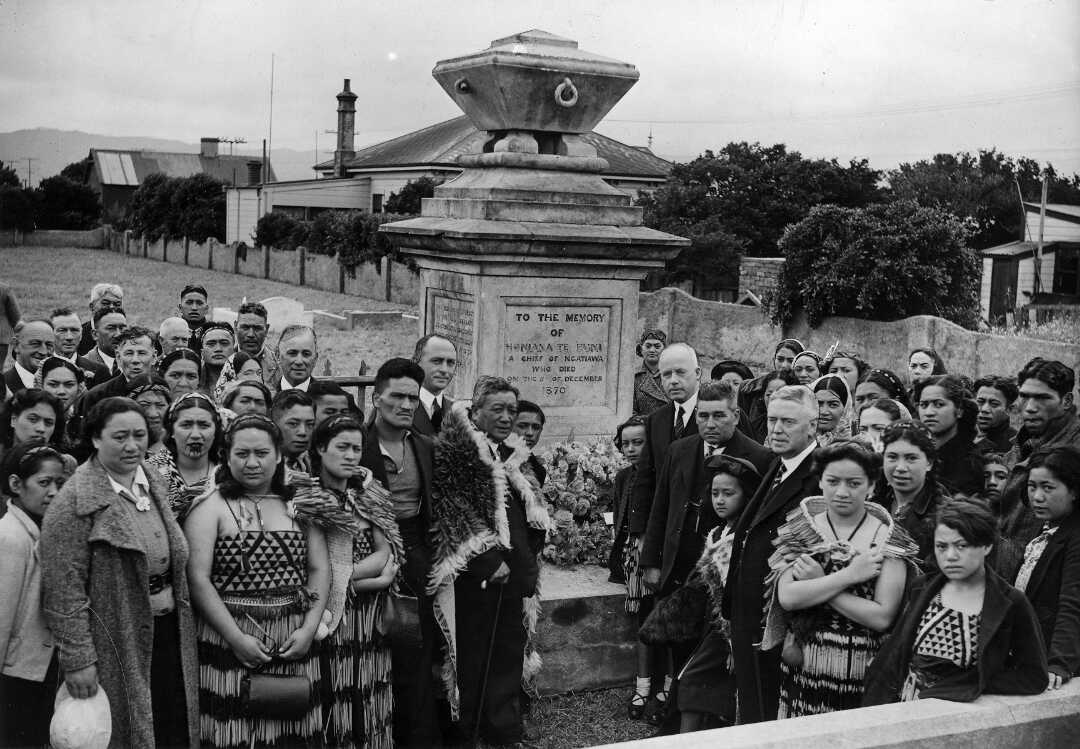 Figure 7 Group of mourners at the grave of Honiana Te Puni, Petone, Wellington. Evening post (Newspaper. 1865-2002) :Photographic negatives and prints of the Evening Post newspaper. Ref: PAColl-5482-004. Alexander Turnbull Library, Wellington, New Zealand. natlib.govt.nz/records/23042299
Today, the last remnants of Pito One Pā – representing just 1% of the original Māori settlement – is Te Puni Urupā. Within the grounds of the urupā stands a memorial honouring the inspiring legacy of Hōniana Te Puni, a remarkable leader during a pivotal period in Aotearoa’s history.