

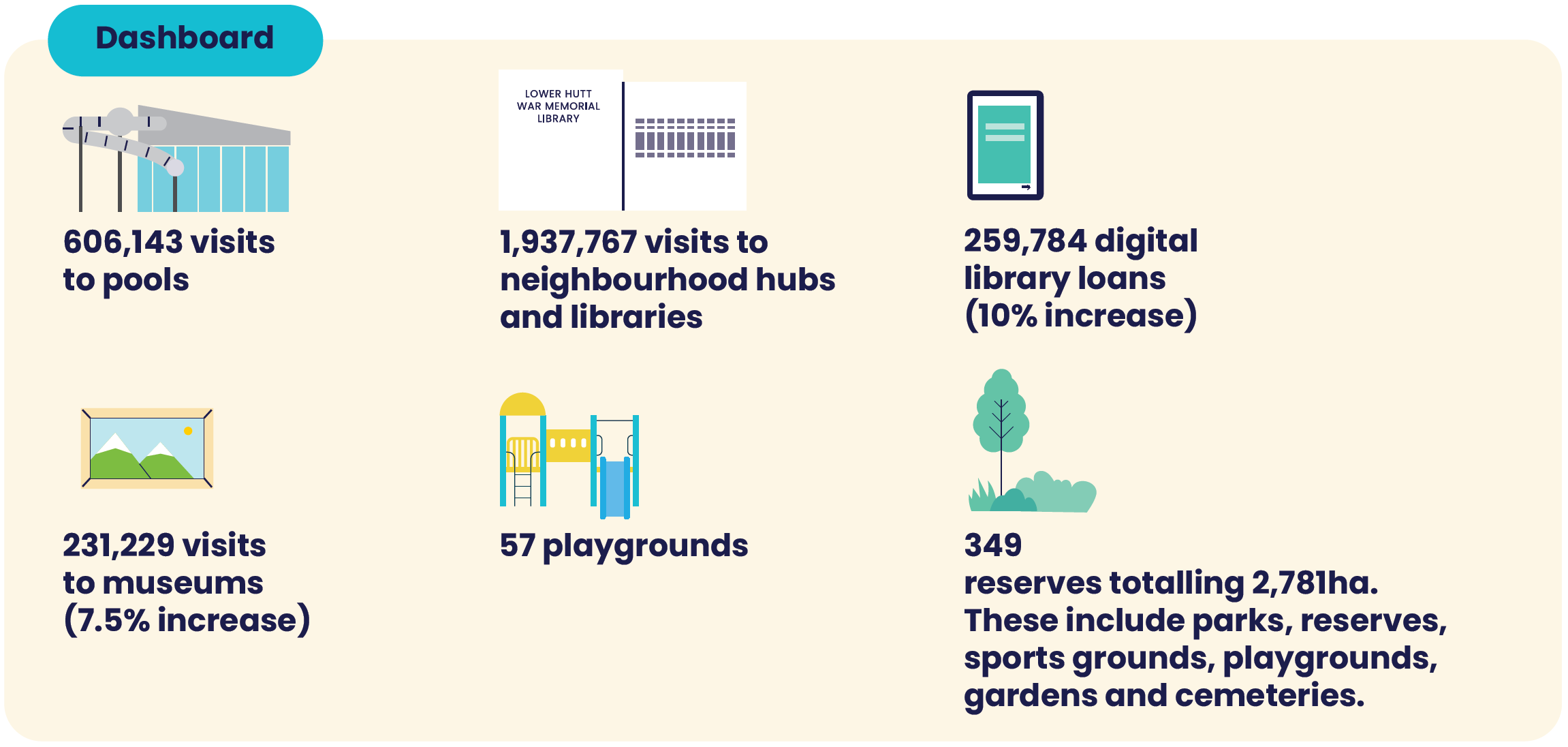
Over the last year we took the next steps in creating a city that promotes a high quality of life for everyone. Easy access to green spaces and community places is an important part of this. Our neighbourhood hubs are places to gather and connect and are central to creating vibrant communities.
Community Connection
Completed in 2026, the two Community Connections projects in Avalon and Taitā are helping create a more connected, accessible and future-fit transport network for our local neighbourhoods.
New separated shared paths, safer crossings and upgraded intersections make it easier and safer for people of all ages and abilities to walk, cycle and scoot between homes, schools, train stations, community facilities and the wider cycling network.
Together, the projects improve access to everyday destinations, encourage active travel, and support healthier, more sustainable transport choices for the growing Lower Hutt community.
Green Flag Honour for Avalon Park
Motutawa Avalon Park received a 2025-26 Green Flag Award in November 2025. The Green Flag Award is the international benchmark for excellence in park and open space management, recognising parks that are welcoming, well maintained, accessible and managed to the highest standards.
Motutawa Avalon Park was one of just 23 parks across New Zealand to earn the recognition in 2025, and the only park in the Wellington region to do so. The achievement reflects Council’s commitment to providing high-quality public open spaces and applying best practice in park management.
Achievements in aquatics
Aquatics celebrated a year of achievement, with national recognition for its facilities and important progress in making swimming more inclusive for everyone.
Te Ngaengae Pool and Fitness received several prestigious awards, including the 2025 Wellington Architecture Award for Public Architecture, the Judges’ Choice Award at the Wellington Property People Awards, the Sport New Zealand Environmental Sustainability Award and the Infrastructure Decarbonisation Award. The awards recognise the facility’s outstanding design, sustainability and contribution to the community.
Council also became an Autism Swim Approved Provider, strengthening support for autistic and neurodivergent children and their families. The Swim School leadership team completed specialist Autism Swim certification, giving staff practical skills to better understand individual needs and adapt lessons accordingly. The programme has introduced tools like visual aids and social stories, helping children feel more confident, supported and included while learning essential water safety skills. By removing barriers to participation, Council is helping ensure more children can safely enjoy the lifelong benefits of learning to swim.
Innovating voter engagement
Encouraging voter enrolment and participation in local government elections remains a challenge across New Zealand. During the election period, Hutt City Council delivered a targeted communications campaign to promote enrolment and voting, with a particular focus on young people and first-time voters.
The campaign used a range of channels, including social media, digital billboards, local newspaper advertising, radio, and, for the first time, Spotify and TikTok. A mayoral debate at the Lower Hutt Events Centre gave residents the opportunity to hear directly from candidates and has since been viewed more than 1,100 times online.
Council also introduced candidate profile videos for the first time and delivered outreach activities in local high schools, including a dedicated event for rangatahi, to encourage greater participation in local democracy.
These efforts contributed to a voter turnout of 41.56 percent, exceeding the national average of 39.42 percent.
Target Operating Model adoption
In February, Council unanimously agreed on a clear direction for Lower Hutt’s future as set out in He ringa miti taki heke Adjusting Our Sails report on our Target Operating Model.
The report outlines a programme to reduce Council’s costs to be able to respond to rates capping and cost of living challenges for the years ahead. Adjusting Our Sails highlights the bold choices Council must grapple with to reduce costs and improve affordability for ratepayers, having exhausted opportunities through years of cost trimming.
If the Government’s proposed rate cap of around 4 percent is to be met, Council needs to save approximately $10M annually by 2030. The report shows that savings of this scale cannot be made without fundamental change to the services Council provides and the assets it owns. This is in an environment where cost increases affecting the economy flow onto councils driving up the price of key infrastructure and roading.
Council’s decision was to approve the recommended “balanced” option of implementation phased over the next three years, with the initial investment for the change programme in year one being approved. Further investment decisions will be considered during the Long Term Plan process.
Any changes will be subject to Council decision-making processes, and engagement with communities and staff.
Council adoption of Te Whiringa
In January, Council strengthened its commitment to meaningful community engagement through the adoption of Te Whiringa, a new engagement framework designed to support earlier, more inclusive, and transparent participation in decision-making.
The framework reflects changing community expectations about how people want to be involved in shaping the future of their city and provides a consistent approach to engagement across Council.
Building on progress made over the past five years, Te Whiringa will help strengthen trust, increase participation, and ensure community voices continue to inform Council decisions and outcomes.
District Plan review
The District Plan review reached a significant milestone during 2025-26, with Council receiving an exemption from the Minister for RMA Reform that enabled progression of a substantial portion of the Proposed Lower Hutt District Plan.
While delays arise from amendments to the Resource Management Act and the exemption process meant hearings were not completed as originally anticipated, hearings commenced in April 2026 and are expected to continue through to the end of 2026.
The new District Plan is expected to be adopted in 2027 (subject to possible appeals), providing an updated planning framework to support sustainable growth, development, and environmental outcomes across Lower Hutt.
City Strategy
Council continued supporting Tō Tātou Tāone 2055, a long-term, community-led strategy that sets a shared direction for the future of Te Awa Kairangi ki Tai Lower Hutt. Shaped by extensive public consultation, the strategy reflects what matters most to the people who live, work and invest in our city.
Community feedback showed strong support for equity, environmental stewardship, thriving neighbourhoods, climate resilience, quality
infrastructure, sustainable transport and opportunities for future generations. Residents also highlighted the importance of creating a
city that supports people of all ages, cultures and backgrounds.
Throughout the year, Council worked closely with the City Leadership Group through a series of workshops to refine the strategy and prepare for its launch.
The group brings together leaders from iwi, central and local government, business, education, health, community organisations and rangatahi, helping ensure the strategy is owned by the wider city.
Setting the new Council up for success
The 2025 local elections marked a significant milestone with the election of Fauono Ken Laban as New Zealand’s first Pasifika mayor. The new Council began the triennium with its inaugural meeting in October 2025, followed by a comprehensive induction programme covering governance, legislation, Te Tiriti o Waitangi, tikanga Māori, finance, strategic priorities, and engagement with Mana Whenua, LGNZ and Council leaders. The programme equipped elected members to fulfil their governance responsibilities from day one.
Property revaluations completed
Legislation requires property revaluations to be completed every three years. These were successfully finalised and approved by the Valuer General, with Council providing a suite of tools, including an explanatory video, a rates impact calculator, and a GIS map showing valuation changes to help residents understand the updates.
City Centre Framework adopted
Council will be adopting the City Centre Framework in July 2026, setting the long-term vision to revitalise Lower Hutt’s city centre and guide future investment.
Te Ara Tupua Opening
Te Ara Tupua opened in May 2026, creating a safe walking and cycling connection between Wellington and Lower Hutt.
City Centre Confidence programme: Hutt Valley NZ
City Centre Confidence supports businesses through capability building, destination marketing with Hutt Valley NZ, and vacant space initiatives such as Pop Up Hutt to attract visitors and boost spending.